
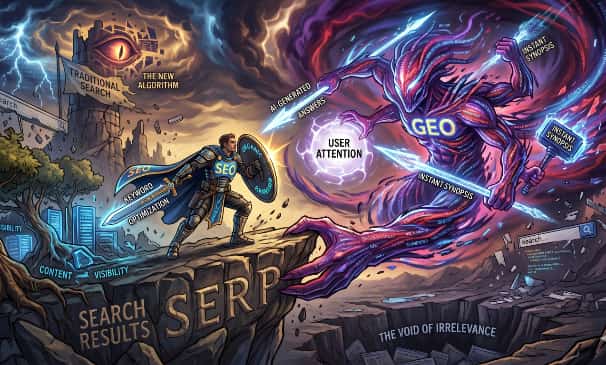
If you have spent any time on LinkedIn in recent months, you will have no doubt witnessed the spat between the ‘AI search is just good SEO’ and the ‘SEO is *definitely* dead and it is all totally different now’ camps.
I will declare my allegiance at the outset – I belong in the battle-scarred SEO crowd and am reasonably tired of all the GEO (Generative Engine Optimisation) and AEO (Answer Engine Optimisation) experts who claim to be the solution to the new AI-powered future.
I should also caveat this general position as I do not want to suggest that AI-driven search is unimportant – it clearly matters. Google’s AI Overviews, conversational search experiences and emerging AI interfaces are genuinely changing how users discover information. To deny that search is evolving would be ignorant.
But that is my fundamental position – it is an evolution rather than a revolution. I have seen no evidence that the fundamentals of good SEO are no longer relevant.
Google Has Spoken
I was therefore happy to read Google’s recently published guide to optimising for AI-powered search experiences.
It is a helpful article that avoids hyperbole and very much encourages webmasters to focus on what, to me, looks very much like good SEO:
- creating original, useful content
- demonstrating expertise and authority
- focusing on user experience
- making content accessible and technically sound
- structuring information clearly
- building trust
There is no secret AI ranking formula. No magical GEO hack. No recommendation to rewrite your entire website for robots.
This will no doubt displease the AI ‘experts’ trying to flog fairly pointless solutions / services / empty promises, but it is interesting to see a direct statement from Google that essentially indicates that optimising for generative AI search is not really any different to optimising for the traditional search experience.
What Is Changing?
As I said, it would be naïve to pretend that nothing is changing.
One area where AI search genuinely does influence content strategy is conversational language. AI-powered search experiences are much more question-and-answer driven. Users are increasingly using (whether by typing or speaking) natural language queries rather than fragmented keyword phrases.
Google’s own documentation highlights the importance of content that is easy to understand, directly answers questions and satisfies user intent.
This is where FAQs, concise answers and well-structured content earn their keep. Ironically, though, none of this is particularly new either. Featured snippets pushed SEO firmly in this direction years ago.
Good copywriters have always tried to answer real user questions. Helpful content has been the stated objective for a long time. AI has simply raised the stakes around clarity and structure.
In practical terms, this probably means writing in more natural language, using clearer headings, adding FAQ sections where appropriate, structuring content logically, using appropriate schema mark up where relevant and providing concise answers before expanding into detail.
Again, this is hardly some radical departure from sensible SEO strategy?
The Dangerous Rise of AI Snake Oil
One slightly depressing side effect of the AI boom is the sheer volume of nonsense now circulating in marketing circles.
Suddenly everyone has an “AI visibility framework.” Every SaaS platform promises “LLM optimisation.” Every LinkedIn guru has invented another acronym.
Google has already started pushing back against manipulative attempts to influence AI-generated search responses and has updated its spam guidance accordingly. Its mythbusting section explicitly names tactics site owners can ignore:
- llms.txt files (yes, you read that right – they are not an elixir)
- content chunking
- rewriting content specifically for AI systems
- pursuing inauthentic mentions
Historically, every time the SEO industry has drifted too far towards shortcuts, automation and low-quality manipulation, Google has eventually closed the loopholes. There is little reason to think AI search will be any different.
Authority Matters More Than Ever
If anything, I believe that AI search actually strengthens the case for genuine authority and credibility.
AI systems need trustworthy sources to cite and summarise. This naturally favours organisations with real expertise, strong brand signals, consistent publishing, high-quality original content and a solid reputation built over time.
Google places particular emphasis on what it calls “non-commodity content” – content that provides a unique point of view, draws on first-hand experience, and goes beyond what could easily be produced by a generative AI model or found in a hundred other articles online.
Cheap, thin, mass-produced content is likely to go the way of the dodo. To be honest, that is very good riddance.
There is, of course, a certain irony here. Everyone is always looking for shortcuts in SEO. AI has been presented as another shortcut. But the businesses most likely to succeed (in the long term) in AI-driven search are more likely to be the ones that have been investing properly in quality, reputation and expertise all along.
Business as usual, really.
There Are No Shortcuts
The more we hear from Google, the more it reinforces a fairly simple conclusion: good SEO remains good SEO.
Yes, there are nuances evolving and yes, user behaviour is changing, so it is entirely sensible to think about how your content is interpreted by AI systems. But the core principles remain stubbornly familiar.
Create genuinely useful content. Demonstrate authority. Understand your audience. Answer real questions. Build trust. Avoid cheap shortcuts.