
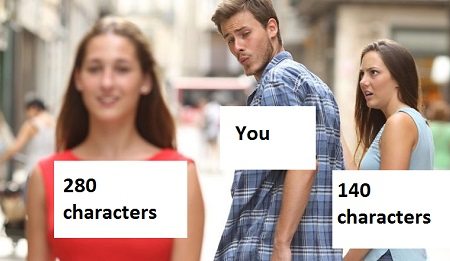
Twitter is rolling out a new 280 character limit for Tweets, doubling the previous character limit, in an effort to help attract more users and allow existing users to “express themselves” more easily.
“We want every person around the world to easily express themselves on Twitter, so we’re doing something new: we’re going to try out a longer limit, 280 characters, in languages impacted by cramming”
– Twitter Product Manager, Aliza Rosen.
In a recent blog post, Rosen pointed to the fact that 9% of English language Tweets hit the 140 character limit, which would suggest a lot of users are carefully editing their Tweets to stay within that limit. The update will be rolled out in all languages affected by “cramming”, which currently includes all languages except for Japanese, Chinese, and Korean. Reason being, in languages like Japanese, it is easier to convey more information in fewer characters. I’m no expert in Asian languages, so you’ll have to take Twitter’s word for it.

Twitter has always been about brevity, and that’s why users – and marketers – love it. Tweets get right to the point (in most cases), and Twitter is confident that doubling the character limit will not affect this. However, in reality, no one really knows what an increased character limit might mean for Twitter as a marketing channel, or whether users truly want it.
Based on what we already know about the update, here are some pros and cons that marketers may have to deal with once ‘280’ becomes a thing.
The potential pros
- More freedom to ‘express’ stuff – The most obvious benefit of having twice as many characters is that it allows for twice as much information to be shared within a single Tweet; More words, more links, more hashtags, more emojis, more stuff. This could reduce the total number of Tweets brands need to push out on any given day, and hopefully mean fewer multi-Tweet messages cluttering up timelines (wishful thinking).
- Improved advertising opportunities – The more cynical among us may see this update as less of an exercise in user expression, and more of an opportunity for Twitter to revamp its less than appealing ad platform – it’s no secret that monetisation has always been an issue for Twitter, so something radical like this could be the catalyst for change it needs. With 280 characters to work with, marketers have a new level of creative freedom, which is bound to attract a wave of new brands who were previously deterred by the 140 character constraint.
- More users – With this change, Twitter hopes to attract more users, which for marketers means more engagement with potential customers. It could also encourage previous Twitter deserters to return to the platform, which again, means more eyeballs for brands. <