
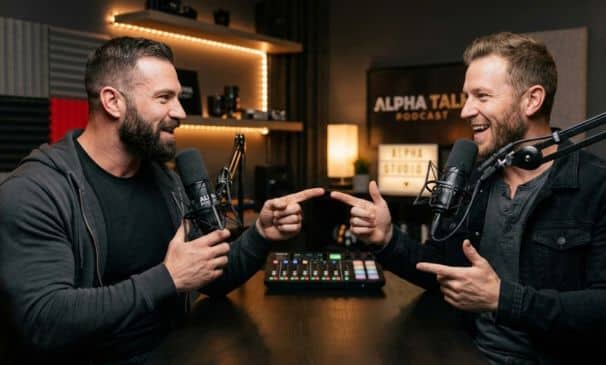
Podcasts have given people with limited resources an opportunity to share their thoughts with a wide audience.
Unfortunately, this has resulted in millions of braindead podcast bros sitting about saying “exaaaaactly” to each other for an hour while talking about being an “alpha male” and how they only date “high-value women”, and other such shite.
With that in mind, you might think it’s easy to start your own podcast. I mean, if they can do it, anyone can, right?
WRONG. Unfortunately, the target demographic for most podcasts isn’t a mad bunch of circle-jerking incels.
So you want to launch a podcast?
For a growing company trying to build market recognition against established industry giants, launching a show requires more than just buying a microphone and hitting record.
If your goal is immediate lead generation, a podcast might not be your best bet. However, if your goal is strategic authority building, it is one of the most powerful tools at your disposal. By creating high-value content with expert guests, you can establish your brand as a credible, trusted voice within your specific niche. It’s a long-term investment in brand equity and trust.
Before you launch into the world of audio, here is a realistic breakdown of the resources required, the pros and cons, and the hidden pitfalls you need to avoid.
1. The investment: what does it actually cost?
Producing a monthly podcast requires a realistic budget for both time and money.
A budget-friendly approach prioritises core audio and video quality on a tighter budget, with the vast majority of production being managed in-house. If you can afford to invest more, higher-end equipment and outsourced technical support can help to save your internal team’s time, while improving the overall quality, and more importantly, reach.
| Category | Low cost | High quality |
| One-time setup cost (mics, cameras, branding) | £600 – £950 | £1,200 – £2,100 |
| Recurring monthly cost (software, hosting, editing) | £120 – £250 | £300 – £600+ |
| Total team time per episode | ~25 hours | ~35 hours |
2. The dream team: required resources
Producing a podcast is a coordinated effort. Even if you have a small team, the workload is best broken down into four distinct roles to avoid burnout:
- The strategist & host (in-house): A media-trained subject matter expert from your company who can lead insightful conversations. This involves research, guest outreach, and hosting. (~10-15 hours/month)
- The producer (in-house): The project manager who organises schedules, coordinates with guests, manages the host’s calendar, and keeps on top of the production timeline. (~4-6 hours/month)
- The editor (outsourced recommended): A technical specialist who edits the audio/video, mixes sound, and creates promotional clips. Outsourcing this is usually the most efficient use of time and budget. (~8-10 hours/month)
- The content team (in-house or agency): Responsible for repurposing the final episode into supporting content (blog posts, social media updates, show notes) to maximise its reach and SEO value. (~5-8 hours/month)
3. The pros: core strategies for success
When done right, a podcast provides massive benefits. For a brand going up against established competitors, success depends on leveraging these four pillars:
- Guest-led growth: Your primary method for reaching new audiences will be inviting guests who have an established, engaged following in your target sector. You get to borrow their audience.
- Hyper-targeted authority: Don’t try to be a generalist show. Become the go-to, undisputed resource for a very specific niche area of your industry.
- A content repurposing engine: Don’t just upload the audio to a single platform and forget about it. Every episode should be sliced into video clips for LinkedIn, transcribed into a full blog post for SEO, uploaded to YouTube with chapters, and turned into quote graphics.
- Consistency: Releasing a show reliably builds deep listener trust and habits. If you say new episodes are released weekly, don’t let the schedule fall behind.
4. The cons: potential pitfalls (and how to fix them)
Podcasting isn’t easy. Here are the most common hurdles brands face, and the mitigation strategies to keep your show alive.
Difficulty attracting high-value guests
- The problem: Influential experts are busy and might see little value in appearing on an unknown, brand-new podcast.
- The fix: Don’t start by aiming for Fortune 500 CEOs. Target smart, “up-and-coming” experts, product managers, or consultants who are actively building their own personal brands on platforms like LinkedIn. Personalise your outreach, tell them exactly what’s in it for them, and engage with their content before you pitch them.
Host availability & deprioritisation
- The problem: Your host is likely a senior leader with massive commercial responsibilities. Podcast prep gets pushed aside for more urgent tasks, leading to cancelled recordings and missed deadlines.
- The fix: Secure formal buy-in from leadership. Podcast blocks must be treated as non-negotiable appointments in the host’s calendar. Better yet, batch record two or three episodes in a single week to build a buffer.
Burning out your team
- The problem: Dumping 25-35 hours of extra work onto a team already managing full workloads leads to burnout. Crucial steps, like promotion and content repurposing, are skipped.
- The fix: Outsource the highly technical, time-consuming task of audio/video editing. Use pre-built templates for show notes and social media copy to streamline the marketing workflow. Use AI tools to help speed up the transcription process (but make sure a human still checks them)!
Impatience and unrealistic expectations
- The problem: After six months, leadership sees low download numbers and wants to cancel the project, comparing it to the immediate metrics of paid ads.
- The fix: Manage expectations from day one. A podcast is an 18+ month brand-building initiative. In the first year, report on qualitative wins: the calibre of guests attracted, positive listener feedback, and the volume of content being created across marketing channels.
5. Setting expectations: the timeline
Building an audience from scratch requires patience. Here is a realistic timeline for a monthly branded podcast:
- Phase 1: pre-launch (6-8 weeks): Strategy development, equipment purchase, branding, and recording the first 2-3 episodes to create a buffer.
- Phase 2: the foundation (months 1-9): Audience growth will be slow and steady, driven by guest networks. Success is measured by process efficiency, not viral numbers.
- Phase 3: building momentum (months 10-18): You’ll see a predictable increase in downloads, improved organic discovery, and greater brand recognition.
- Phase 4: scaling (months 18+): Review performance and refine KPIs with more focus on quantitative metrics, such as subscribers and streams, and, where possible, attribution/influence throughout the marketing funnel to begin calculating ROI.
6. Know your landscape
If a competitor has been running a podcast successfully for several years, you need to think about why someone would choose to listen to your podcast as well as, or instead of, theirs. Before you hit record, audit your specific niche. What are your competitors doing? Who are they talking to?
Look at how many subscribers they have, read reviews and comments, and check what levels of engagement they have when sharing content from the podcast across social media.
Review every single episode they have ever published to identify gaps in their content strategy or see if popular topics which have already been covered could benefit from a new take.
Make a record of the guests they have had on and create a matrix of how likely they are to feature on your podcast, too.
Analyse their core demographics and assess how much crossover there is with your ideal customer profile.
Finally, collate all of this information and build a plan for each of your competitors to map out all of their strengths and weaknesses.
Example: a quick audit of the SEO podcast landscape reveals a mix of highly influential generalist shows and highly niche, brand-owned or expert-led pods.
| Podcast Title | Host/Producer | Focus Area | Reach & Scale (Est.) | Target ICP | Key Strengths | Key Weaknesses |
| The Search Engine Journal Show | Search Engine Journal | Broad SEO & digital marketing news | 40k+ (YT); High global reach | Enterprise SEOs, Marketing Managers, & Agency Leads. | Industry “journal of record”; access to Google/Bing search reps. | Can feel corporate or dry; less focus on “how-to” for solo/small sites. |
| Authority Hacker | Gael Breton & Mark Webster | Affiliate marketing & AI automation | 46k+ (YT); 3.5M+ total downloads | Affiliate Marketers & AI-driven Entrepreneurs. | Actionable “field reports”; excellent data-driven AI experiments. | Heavy promotion of their own courses; can be too advanced for beginners. |
| Crawling Mondays | Aleyda Solis | Technical and international SEO | 13k+ (YT); High niche influence | Technical SEO Specialists & International Consultants. | Deeply technical; global perspective; high-calibre guest list. | Highly specialised; may be intimidating for generalist marketers. |
| Wix SEO Hub Podcast | Wix | SEO industry trends & brand building | Niche (part of 100k+ Wix ecosystem) | General Marketers & Wix CMS users. | High production value; simplifies complex SEO for the “average” user. | Perceived brand bias; limited focus on non-Wix technical stacks. |
| The Recipe for SEO Success | Kate Toon | Small business SEO & copywriting | Niche: Highly engaged Australian/global base | Solo-preneurs, Freelancers, & SME owners. | Jargon-free and empathetic; focuses on the “human” side of SEO. | Less relevant for enterprise-level scale or heavy technical automation. |
Notice how the brand-owned or expert-led podcasts don’t try to cover the entire industry; they carve out a highly specific niche. That is the blueprint for a successful branded show.
The reality of a branded podcast is that it’s a high-stakes, resource-heavy grind. You aren’t just competing with industry rivals; you’re competing for the finite attention span of a professional audience that has a zero-tolerance policy for filler and fluff.
If you’re not saying anything new or are trying to compete in an overcrowded market, you’re setting yourself up to fail. However, if you have the budget to do it right, the patience to hold out for long-term ROI, a niche specific enough to own, and a solid budget to support it, a branded podcast can be a great way to build a loyal, trusted audience.