

I first came across Surreal on LinkedIn, and it truly was love at first sight. Their marketing worked so well that I now have a bowl for breakfast most mornings. Their marketing strategy is unique: it’s bold and brave, while also being utterly ridiculous. Let’s take a look at some aspects of their strategy and why it works so well.
I think it’s only fair to mention that I do fit perfectly into their ideal customer profile. Gym-goer (sucker for a ‘high-protein’ label), but also lazy (desiring a breakfast option that’s as easy as it is tasty). Gen-Z (with meme-culture ingrained in my soul) marketer (that appreciates chaotic humour). Their strategy was made for me, hence why my indoctrination into Cult Surreal was so seamless and why this blog post may appear a bit biased. But try to look past that. It’ll be worth it, I promise!
Brand positioning: guilt-free nostalgia
The cereal market is incredibly saturated, with big-name brands with recognisable IPs and bottomless marketing budgets dominating the space. Supermarket shelves stock flashy, sugary kids’ cereals alongside the plain, somewhat utilitarian ‘healthy’ cereals, which are clearly aimed at adults but leave a lot to be desired.
The key to successfully breaking into an oversaturated market is to reframe it. Surreal cleverly positioned itself in the gap between the two, creating a fun and functional hybrid that combines a high-protein and low-sugar recipe with a genuinely tasty result (their cereals are also gluten-free, which is another market gap win!). They’re capitalising on guilt-free nostalgia: a cereal that tastes like childhood but is aimed at adults, fitting modern health and fitness goals.
It might sound like their products are aimed at health-obsessed clean eaters, but I’d take a stab and say that they’re actually more focused on fitness-conscious Gen Zs and millennials who want breakfasts that are both functional and fun. This will make more sense as we delve into their marketing efforts.
Creating a cult following on LinkedIn
LinkedIn is traditionally a B2B platform, and many B2B brands are reluctant to branch out and get chaotic in fear of coming off unprofessional. Despite being B2C, Surreal has curated a genuine cult following on the platform, with content that is self-aware, meta (marketers making jokes about marketing), and designed with virality in mind, which is key to success in the social media era. I can never resist clicking through a new Surreal LinkedIn carousel, because you truly never know what you’re going to get.

Source: Surreal via LinkedIn
Surreal’s secret to success (or at least part of it) is targeting marketers, not necessarily as consumers but as an amplification method, because marketers love clever marketing. I’m constantly sending fun and unique posts to my friends, to the extent that most of them have received a few of Surreal’s posts in their LinkedIn DMs (they’re always swiftly notified when a new supermarket chain begins to stock Surreal, as I am both a fan and a volunteer PR team).
Getting marketers talking about your brand is a great way to generate reach, but you need to be doing something different to pique their interest. It’s not always about social media best practices anymore. In 2026, social media has its own culture, and Surreal has mastered the methods needed to lean into it.
Chaotically unhinged paid media
When you’re up against well-known brands like Kellogg’s and Nestlé, you need to get creative with your paid media. Surreal has steered away from big TV spends, celebrity endorsement budgets, and glossy production values, instead utilising high-creativity campaigns that highlight the same playful personality as their social media presence.
They’ve expertly blurred the line between ads and content, leveraging a playful nature that evokes sharability. Their out-of-home (OOH) advertising and experimental campaigns aren’t just designed for people walking past on the street; they’re designed to be photographed, shared, and talked about online. They act as a content creation tool, not just a means of generating brand awareness.
Here are some of my favourite examples.
Fake celebrity billboards
Surreal took an absolutely brilliant approach to celebrity endorsement. Using celebrity names to catch your eye, the billboards immediately reveal that we’re not actually talking about the celebrity, just a normal person with the same name. It’s clever, unexpected, and most crucially, it’s the kind of thing that makes you snap a picture and share it with a friend, family, or the wider internet.


New year, can’t be bothered
For a campaign executed in January, when every other brand is pushing the ‘new year, new you’ self-help messaging, Surreal embraced a ‘can’t be bothered’ attitude and threw out their usual branding in favour of stock images and WordArt.
The anti-perfection stance against a sea of sleek, aspirational designs made Surreal’s campaign stand out from the crowd, but that isn’t the only reason I think these designs were genius. A large portion of Surreal’s target customer base is regular, athletic gym-goers who keep tabs on their food and macro intakes throughout the year, not just in January. The ‘new year, new me’ messaging rarely ever resonates with this demographic, because they’re always striving to be better, not waiting for January for a massive overhaul.

Unexpected collaborations
Unexpected crossovers from any brand are a personal favourite of mine, and Surreal is no exception. Launching a campaign or limited edition product with a completely unrelated brand not only provides the shock value needed for a viral moment, but also increases reach, allowing you to tap into new customer pools.
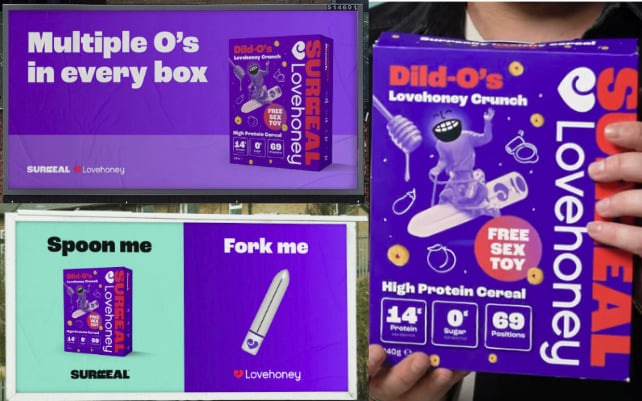
Lovehoney
What do sex toys and cereal have in common? Well, nothing really. Not unless they team up to create a limited edition cereal named ‘Dild-Os’. The boxes even came with a free sex toy, relating back to the long-outdated idea of cereal boxes containing toys. It’s outrageously funny, and a perfect way to get people talking.
Harder, Feta, (break)Faster, Stronger
This is my personal favourite. Coordinating with three other brands, Numan (erectile dysfunction medication), Cheesegeek (online cheesemonger), and Gymbox (fitness company), they created a series of four billboards that play off the iconic Daft Punk lyrics. The wordplay is great, and the mismatch of brands is even better.

Grind
In collaboration with coffee company, Grind, Surreal launched a tiramisu flavoured cereal. While coffee and cereal make more sense together than the previous two, I still think this was a clever launch to generate buzz, especially while tiramisu is having its moment on social media.

Gymshark
This is another collaboration that does make sense, considering it’s likely that large portions of Surreal and Gymshark’s audiences cross over. I mainly wanted to include it to honour the brilliant name on the box: ‘Cardi-Os’.

Honourable mention: Have you seen this dog?
A slight stretch from marketing, but it’s my blog post, so I can do what I want. I have to mention my favourite part of Surreal’s box design: Have you seen this dog? (It’s not missing, just cute!)
It’s a tiny detail that has nothing to do with selling cereal, but it makes you smile and reinforces the brand’s playful nature. They even encourage customers to send pictures of their own dogs for inclusion. I noticed it immediately upon purchasing my first box, and I love it – I’m patiently waiting for my own dog to appear on the box one day (fingers crossed!).

Image source: Me, in my kitchen
The psychological secrets to success
Surreal’s marketing strategy may seem random, but their success is built on solid psychological principles that many marketers leverage to their advantage.
Nostalgia
Surreal has crafted a product that taps into childhood memories. The taste takes you back to the cereals of your childhood, back before anyone cared about macros, and the boxes are bright and colourful in a way that reminds you of Saturday morning cartoons. These positive associations trigger the feeling of nostalgia, which is a powerful emotion that influences buying decisions.
Relatability
Understanding your audience is a Marketing 101 basic, but there’s knowing your customers and really knowing your customers. Surreal knows their audience at a granular level: fitness-conscious millennials and Gen Z want high protein delivered in a fun way, and marketers appreciate meta humour. Many of their customers are chronically online (guilty) and respond to meme culture. This deep understanding forms the basis of their strategy and it really shows.
Anti-marketing
Surreal adopts anti-marketing tactics in a few different ways. For starters, plenty of their content pokes fun at traditional advertising, showing self-awareness and building trust in a world of over polished brand messaging. While other brands push glossy perfection, Surreal uses imperfection as a differentiator. Their visuals don’t look like traditional advertising, which, considering that many modern consumers resent being sold to, is likely a big contributor to their success.
Pattern interruption
Following on from anti-marketing, Surreal’s ads that push back against usual design principles interrupt the pattern we expect from advertising. Our brains pay attention to things that deviate from the norm, which is exactly why these campaigns work so well.
Community & shareability
Everything Surreal creates is designed to be photographed, screenshotted, and reposted. Organic reach is increasingly difficult to achieve, so by creating ads that perform like content, they’re capitalising on the viewers who share with their friends, colleagues, and followers. Not only is this free exposure, but it also creates a sense of community, bringing people back to your profiles to see what’s coming next, just for the opportunity to share it with those close to them.
More than just another cereal company
Traditional cereal brands have big budgets, but they’re constrained by legacy brand guidelines and risk-averse stakeholders. Many are likely stuck in the trap of ‘this is how we’ve always done it’.
Surreal isn’t just selling cereal; they’re selling content people want to talk about. They had the freedom to be weird and bold, and they took that and ran with it. The result is genuine cultural relevance and a community that truly cares (I’ve literally dedicated this entire blog post to brown-nosing their marketing team, so you can’t deny that the community does truly care).
On paper, their strategy shouldn’t necessarily work. Using fake celebrities is misleading. Low-effort design is sloppy. Marketing jokes have nothing to do with cereal. Yet, here we are. I’ve had a bowl of Surreal just this morning, and now I’m wrapping up a blog post about their success.
In a world where everyone is following the same playbook, be brave enough to throw it out.