
Whether you’re chronically online (guilty!) or not, I’ll hazard a guess that you’ve seen at least one example of the latest marketing craze on social media. Disguised as a serious corporate apology statement, brands have been shouting about how great their products and/or services are.
Where you’d expect to see news of a data breach or a problematic campaign, you’re instead hit with “We sincerely apologise for making our product so good that you can’t stop using it.”
I’ll admit that the first time I saw this style of post, I laughed. But then I saw another brand doing it. And another. And another. It’s officially a trend, so let’s talk about it.
What is the Official Apology trend?
Reportedly, the trend started in the Philippines in 2024 as an internet meme, slowly gaining traction before absolutely exploding globally in November 2025, conveniently timed with the lead-up to Black Friday.
Social media marketing in 2025 operates within the ‘attention economy’, an economic model that treats human (consumer) attention as a scarce resource that is captured and monetised. There is a limited amount of attention in a day, so businesses and other online creators compete to capture and hold it.
These posts represent the latest way brands are trying to go viral and drive engagement. The format is incredibly specific, mimicking the structure of actual corporate apologies we’ve all seen before, and that is exactly why it works.
The formula
Each post features a visual that resembles a serious corporate announcement, complete with a large, bold “official apology statement” title that instantly captures attention, stopping scrollers in their tracks. The first few lines sound like they were drafted by a legal team, creating immediate feelings of legitimacy. “It has come to our attention…” “We sincerely apologise for…” “We take full responsibility for…” Then, the punchline hits. The brand isn’t sorry for a scandal, a mistake, or any actual wrongdoing. They’re apologising for something positive, like their product being too good, their deals too irresistible, or their service too convenient.
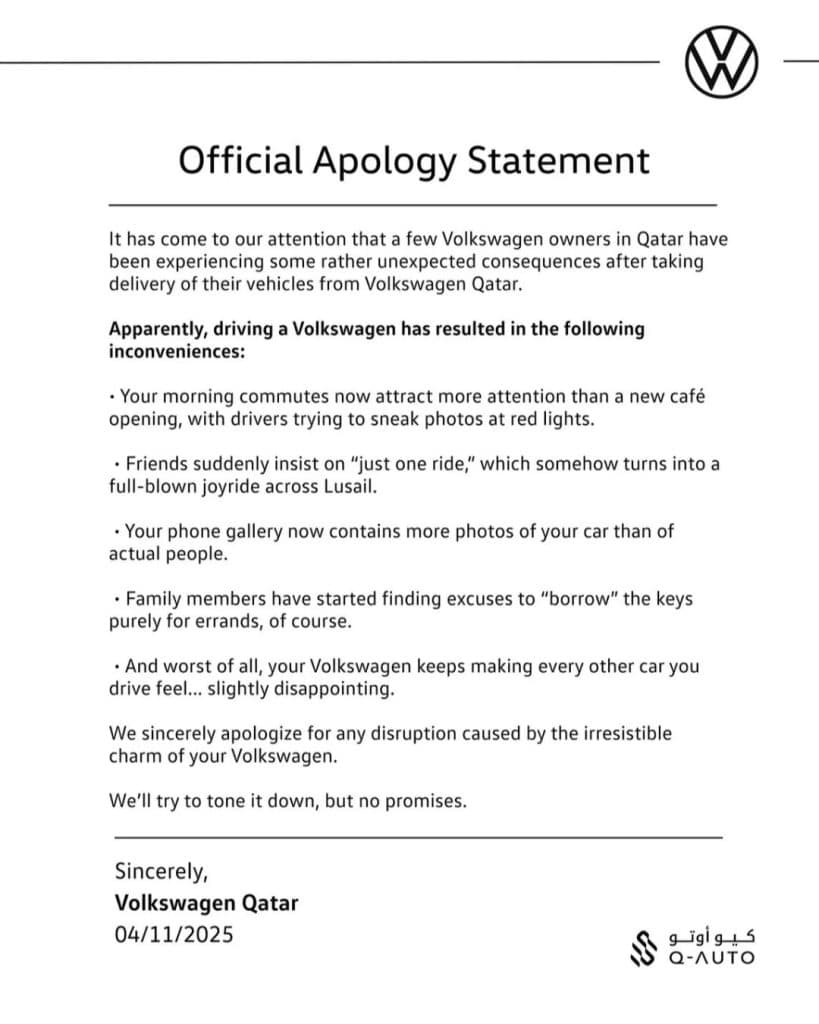
Take this example from Volkswagen Qatar. Company headered, a serious font, and a formal introduction, just to ‘apologise’ for “the irresistible charm of your Volkswagen”.
Why the Official Apology trend works
While there’s been a fair bit of backlash over this trend, from a marketing perspective, it can be fairly clever when executed correctly.
Successful scroll-stopping
It’s becoming increasingly difficult to get consumers to actually read something. Attention spans are shorter than ever, and the new normal is to scroll past content that doesn’t immediately grab our attention. But if something looks like a serious corporate statement, users instinctively pause. It’s the same reason we slow down when we see an accident on the motorway – we’re curious, we want to know what happened. That initial pause is the holy grail in the attention economy.
Humour drives engagement
Social media is inherently unserious, and users love content that is funny or ironic. They like it, comment on it, and share it with friends who’ll appreciate the joke, and when people interact with content, the algorithm shows it to more people. It’s a self-perpetuating cycle of engagement that brands strive for.
The element of surprise
This trend plays with people’s emotions, laying the foundations for a crisis and then softening the blow with a joke. This is especially effective if it’s a brand the user genuinely cares about. That moment of “oh god, what did they do?” followed by relief and laughter creates a strong emotional response, unsurprising in this era of parasocial relationships.
An ad that doesn’t feel like an ad
These posts are entertainment first, promotion second – soft sells disguised as participation in internet culture. You don’t just passively see it; you’re in on the joke.
Embracing internet culture
This trend has been circulating on the internet, leaning into the meme format that is popular across social media platforms. This format is designed for young millennials and Gen Z, who historically love meta-humour and irony. Brands participating in the trend can show an understanding of internet culture, becoming part of the conversation and displaying how they’re not hell-bent on taking themselves too seriously.
Low production, high payoff
Joining this trend is simple. You don’t need a massive production budget, just some basic Canva skills (yes, even just with the free version) and a good understanding of the format. From a practical standpoint, the ROI is enormous.
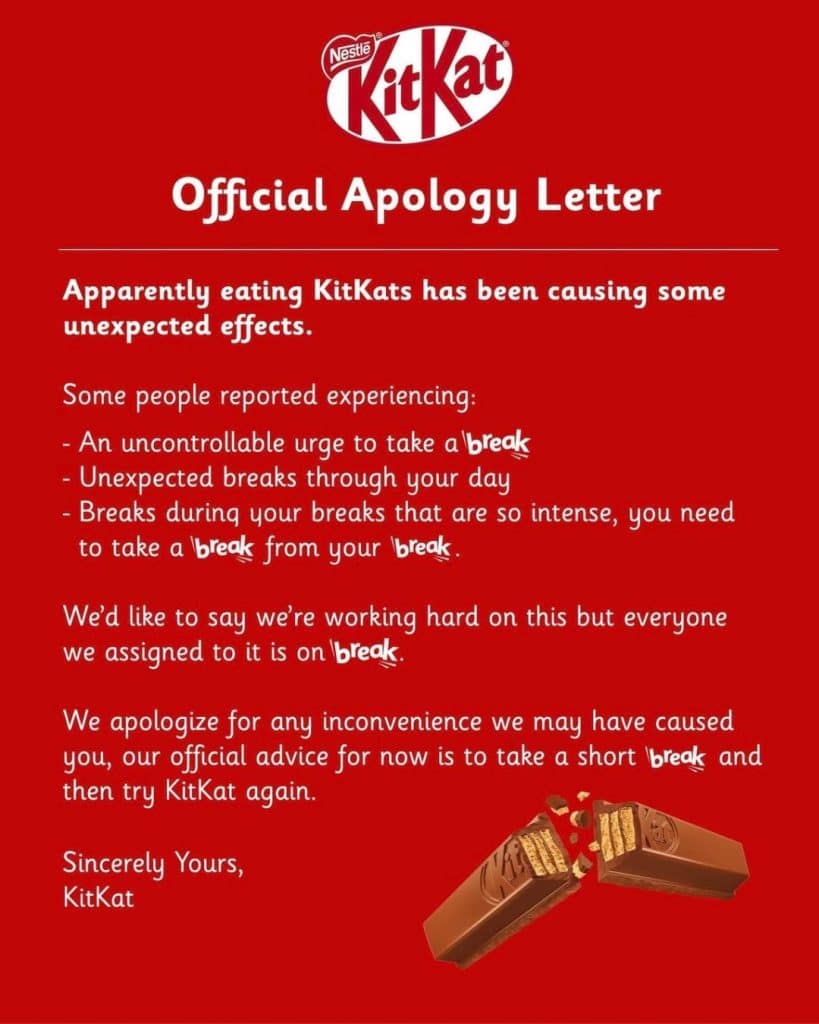
KitKat’s contribution to the trend was the first that I saw, and, in my opinion, one of the few that has done it right. They’ve leaned into a playful design, opting away from serious fonts and keeping a somewhat obvious distinction between a real apology statement. However, from a glance while scrolling through social media, this is less obvious, so the vital first step (attention capture) is still there.
Who should jump on this trend?
At this point, no one. That ship has sailed, but more on that later. Let’s pretend we’re back at the origin days of this trend. What brands should join the noise?
A key factor is tone of voice. Brands with established playful voices that already lean into jokes and satire-based content can capitalise on this format without taking their audience too much by surprise. Consumer lifestyle brands like beauty, fashion, and food and beverage companies with playful personalities could be a great fit, as well as digital-native brands with young audiences that expect humour and trend participation as standard.
The backlash (it is the internet, after all!)
Here’s where things get complicated. For every brand successfully joining this trend, there are countless examples of it backfiring spectacularly, and even the successful ones are facing some criticism.
Take this example from Indian cinema company, PVR INOX. A quick look into the comments section told me everything I needed to know about how this stunt landed with the brand’s audience.


So, other than the above example of consumers just flat out disagreeing with your positive claims, what else can go wrong with the Official Apology trend?
Context fatigue
Many users feel the trend has been massively overplayed. What was clever and funny when the first few brands did it has become tiresome now that everyone’s jumping on the bandwagon.
The issue with viral trends is that the window of effectiveness is incredibly narrow. By the time most brands have gotten approval, created the content, and posted it, the trend is already feeling stale, and audiences are quick to roll their eyes at brands arriving late to the party.
Feelings of deception
Some users feel genuinely tricked when they realise these aren’t real apologies. That initial moment of concern, followed by the reveal that it’s just a marketing stunt, can create a negative association rather than relief and humour. Views don’t equal trust, and engagement doesn’t always equal positive sentiment. If people feel manipulated, that’s not a win for your brand.
The boy who cried wolf problem
PR experts have been quick to share their thoughts on this trend, and it’s not good. The biggest concern is what happens when a brand that’s posted fake apologies needs to issue a real one? If you’ve trained your audience to view your “official apology statements” as humorous, how do you rebuild that serious tone when you genuinely need it? You’ve essentially diluted the credibility of your crisis communication before you’ve even had a crisis.
Getting insensitive
On a serious note, ironic apologies can feel dismissive if the company operates in a space where real harm is possible, and if a brand has actual unresolved controversies or recent scandals, participating in this trend looks wildly tone-deaf. Reading the room is crucial, and many brands are failing this test.
For example, finance and insurance companies that deal with serious trust or financial risk should never lean into a joke about apology-style messaging, and anything tied to safety, crisis response, or vulnerable communities should also skip the trend entirely (duh!). I’d like to say that government and public services should also avoid jumping on this particular bandwagon (or any other ‘bangwagon’ to be honest). However, you’ve probably seen the state of some government official’s social media profiles, so who knows anymore. But that’s a whole blog post topic in itself, and we’re not going there today.
The verdict
I feel like this trend is clever in concept, but risky in execution. The brands that got in early, had the right tone, and genuinely understood the format? They probably saw some decent engagement and maybe even positive sentiment. But the hundreds of brands jumping on now, weeks after the trend peaked? They’re not being clever or culturally relevant.
Jumping on a viral trend can be risky. Do it wrong, and you look out of touch, desperate, or worse – you undermine your own credibility for when you genuinely need to communicate something serious.
So, should your brand participate in the fake apology trend? Maybe. But ask yourself: are you doing it because it genuinely fits your brand and you have something clever to say? Or are you doing it because everyone else is, and you’re terrified of being left out?
If it’s the latter, maybe that’s what you should actually be apologising for.