

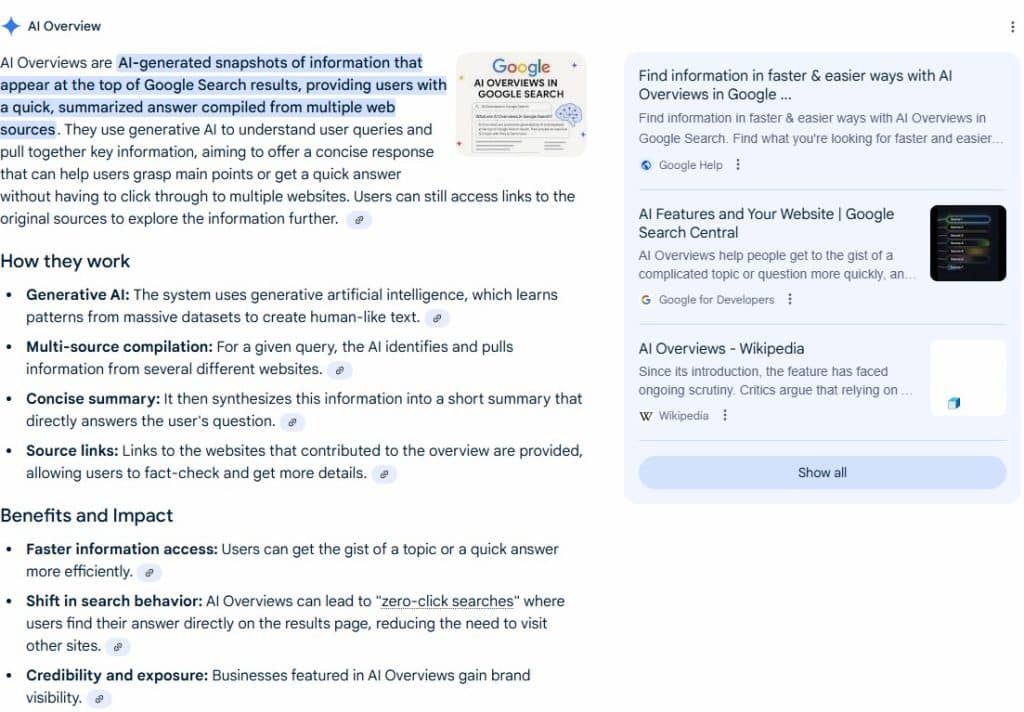
You’ve almost certainly seen it by now. Ask Google a question, and a full, AI-generated paragraph often appears at the top of the page, giving you a direct answer. These are known as ‘AI Overviews’ (AIOs).
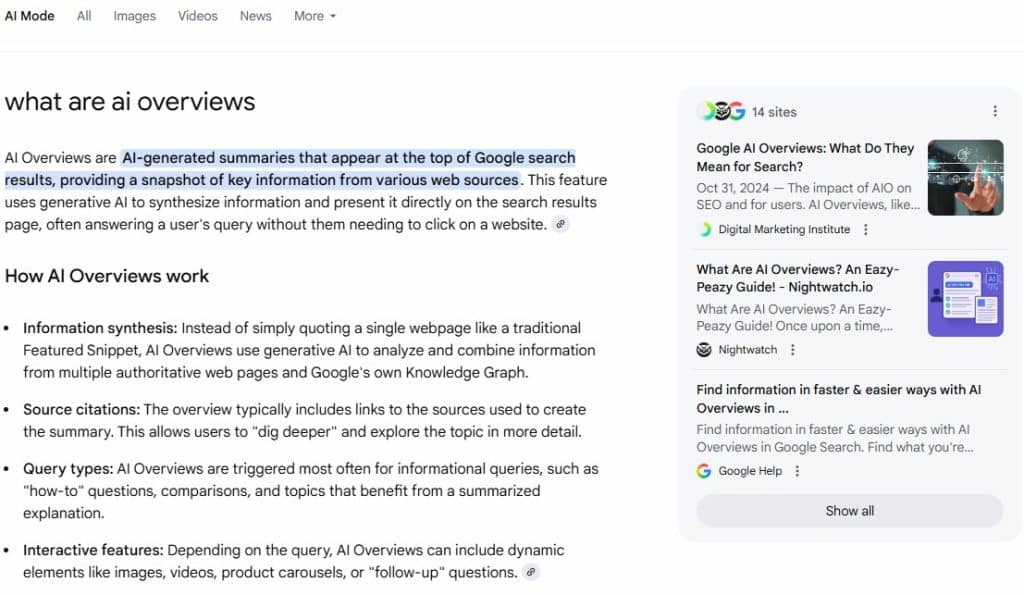
But it doesn’t stop there. Google recently rolled out a more conversational experience in Google Search, referred to as ‘AI Mode’, where users can have a back-and-forth dialogue with the engine, refining their questions and diving deeper into topics, as they do with other popular AI agents, such as ChatGPT, Perplexity, and Claude.
This is a fundamental change to the search landscape. And now, Google needs to monetise these new AI features in an attempt to make up for risking its precious revenue stream, as advertisers have begun to report huge drops in ad click-through rate (CTR) – a direct result of AIOs pushing paid ads down the page.
Google is framing it as a ‘golden opportunity’ for brands to connect with customers at a moment of high intent by targeting users with ads across both AIOs and within AI Mode. But for many businesses, especially those with tight budgets and operating in niche industries, the reality is that high costs and a lack of transparency may prevent them from being able to experiment with showing ads in AIOs and AI Mode.
So, what’s the reality? Is this a game-changing opportunity or a dangerous gamble? The truth is, it depends entirely on your business, your budget, and your appetite for risk.
While it’s not yet available in the UK, businesses should be weighing up the pros and cons of running ads across Google’s AIOs and AI Mode ahead of its rollout later this year.
When is AI Overview and AI mode advertising launching in the UK?
While no specific date has yet been confirmed, AI Overview and AI Mode ads are expected to launch in the UK during Q4 2025.
AI Overview ads are currently live for English-language users in the United States across both mobile and desktop platforms. Ads in AI Mode are currently in beta.

How do I get ads to show in AI Overviews and AI Mode?
At present, text and shopping advertisements from existing Search, Shopping and Performance Max campaign types are able to appear within AI overviews.
To get your Google Ads to show in AI Overviews and AI Mode, you need to align your campaigns with Google’s AI by using automated, intent-based tools like broad match keywords and Performance Max (PMax) campaigns. There isn’t a specific button or setting to “turn on” these placements; eligibility is achieved by adopting the tools that allow Google’s AI to match your ads to complex, conversational user queries.
The most critical step is to shift from restrictive, manual campaign structures to more flexible, automated ones. This gives Google’s AI the data and freedom it needs to find relevant placements in AI-generated content.
Use broad match keywords
Yep, as if the targeting on exact match and phrase match wasn’t already loose enough, you will have to use broad match if you want your ads to appear in AIOs and AI Mode. AI-powered broad match is about matching the intent of a search, not just the specific words. Conversational queries in AI Mode (e.g., “what are the best waterproof trainers for running on trails in the UK?”) don’t look like traditional keywords. Broad match allows Google to understand the underlying intent of that complex query and match it to your ad for “waterproof trail running shoes.” Paired with Smart Bidding strategies like Maximise Conversions, it’s a powerful way to ensure you’re eligible to appear.
Or, if you’re really brave, do away with keywords altogether and use the AI Max in Search setting instead.
Leverage Performance Max
Performance Max (PMax) is an all-in-one, goal-based campaign type that is designed for the AI-driven ad landscape with intent-driven targeting. PMax is designed to find converting customers across all of Google’s channels with a mix of text, image, and video ads formats, and because it operates on broad intent signals rather than specific keywords, it’s a natural fit for placing ads within AI Overviews and AI Mode conversations. If you want to maximise your chances of appearing in these new formats, running a PMax campaign is your best bet.
Optimise your Shopping feeds
For e-commerce businesses, it’s important not to overlook shopping feed optimisation. Your product feed acts as the foundation that helps Google’s algorithm understand your inventory and match it to relevant searches. Key optimisations include strategically placing keywords in product titles and completing comprehensive product attribute data. As Google integrates Shopping ads into AI Overviews and AI Mode, feed quality directly impacts your ability to appear in these intent-driven, AI-generated responses where Google’s algorithm relies heavily on comprehensive product data to make relevant matches.
Note that the platform currently excludes adverts from sensitive categories, including adult content, alcohol, gambling, financial services, healthcare, political content, and other restricted verticals from appearing in AI overviews.
How do ads appear in AI Overviews and AI Mode?
- In AI Overviews: Ads are integrated directly within the generated summary and are clearly marked with a “Sponsored” label. For a search like “best walking boots for the Peak District,” the AI Overview might summarise key features to look for and then seamlessly include a sponsored link to your product page or a full product ad with an image, price, and rating. The ad appears as a natural part of the solution the AI is providing.
- In Google’s AI Mode: During a conversational back-and-forth, an ad can appear as a logical next step. Imagine a user asks about holidays in Cornwall, then refines their search to ask about family-friendly cottages near a beach. After the AI provides some options, it might then present a relevant sponsored ad for a specific cottage booking site, triggered by the intent of the entire conversation.
In both cases, the ad is placed based on the AI’s understanding of the user’s complex intent, rather than a simple keyword match.
What are the benefits of running AIO/AI Mode ads?
For certain businesses, advertising within these AI-powered results could be a huge advantage. The potential benefits are tied to connecting with customers in a new, more effective way.
Shorter customer journeys
When a user asks a complex question, the AI does the initial research for them. If your ad appears within that summary, you are positioned not just as an option, but as a direct solution. This can dramatically shorten the consideration phase, leading to highly qualified leads.
A win for complex enterprise businesses
If you sell a product or service that requires research and comparison (think B2B software, high-value electronics, or financial products), this is for you. The AI’s ability to understand “derived intent” means it can match your solution to a user’s complex problem, moving beyond simple keywords.
Unlocking new growth
For businesses focused on scaling, the AI-powered tools Google advocates for (like Performance Max) can uncover new audiences and drive growth in ways that manual campaigns cannot. By feeding the AI your business goals, you can potentially find new pockets of customers you didn’t even know existed.
What are the risks of running AIO/AI Mode ads?
While the potential is clear, the risks are just as significant, particularly for advertisers who need predictable returns and granular control.
Budget drain for smaller advertisers
To appear in these new formats, Google is pushing advertisers towards broad match keywords and PMax. For a local service business, a small e-commerce store, or a startup SaaS business with much larger competitors who need to stick to a tight budget, this is a major risk. Broad match is notorious for its ability to burn through a daily budget on irrelevant clicks, and the ‘fail fast’ approach needed to make it work is a luxury many can’t afford.
The critical transparency gap
This is a major issue for everyone. Currently, performance from ads in AI Overviews and Google’s AI Mode is bundled into your regular campaign data. You cannot isolate the data to see if these new placements are actually working. Without being able to measure the return on investment, you’re simply spending in the dark. Google has stated that search queries in the Search Terms Report might be broken down in future, but I wouldn’t hold my breath. Adding masses of negative keywords will be absolutely necessary to control wasted spend – difficult to do when there is a lack of transparency in the search terms, though.
A strategic loss of control
The move towards these solutions means handing the keys over to Google’s algorithm. You lose direct control over bidding, placements, and, to some extent, the precise queries your ads show for. This is a significant strategic shift away from the data-led optimisation that has long been the hallmark of a successful ads account.
Is showing Google Ads in AIOs and AI Mode right for my business?
The right approach depends entirely on your business model and resources.
This could be a great opportunity for:
- Businesses with flexible or large budgets that can afford to test, learn, and absorb some initial inefficiency.
- Growth-focused companies where scaling and finding new audiences is a higher priority than immediate, granular ROI on every pound spent.
- Companies in complex B2C or B2B sectors whose customers ask detailed, consultative questions before making a purchase, or completing a lead form, requesting a demo, signing up, or getting in touch.
You should proceed with caution if you are:
- A small or local business with a tight, fixed marketing budget that needs to be maximised for leads.
- Any advertiser who relies on predictable, measurable ROI to justify their marketing spend.
- A business in a highly competitive, high cost-per-click industry where irrelevant clicks from broad match terms can be financially crippling.
The arrival of generative AI in search is not something to be ignored, but it doesn’t demand a knee-jerk reaction either. Rather than viewing it as a binary choice between embracing the future and being left behind, advertisers should see it as a new set of strategic tools that may or may not be right for them at this moment.
Evaluate your own business goals. If you have the budget and business model to benefit from reaching high-intent users early in a complex journey, then dedicating a small, ring-fenced test budget could be a smart move – especially if your competitors aren’t. For everyone else, the prudent approach is to stick with the control and predictability of well-managed phrase and exact match campaigns.
My advice – keep a close eye on developments, but don’t feel pressured into a gamble your business can’t afford to lose.