
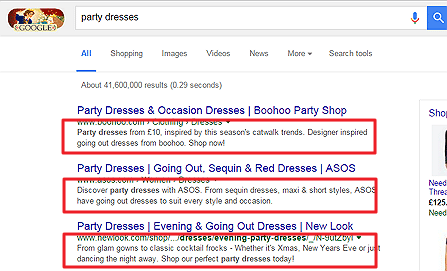
Party season is a somewhat distant memory right now, however, it did provide me with a great insight into the ways in which brands can utilise their meta descriptions to influence potential customers, like myself.
While it is said that meta descriptions are not considered a ranking factor, they shouldn’t be disregarded altogether. Instead, consider your meta descriptions as a click through and conversion factor, if they are well thought out and well written, your pages stand more chance of capturing the right attention and hopefully generating more clicks.
After receiving a New Year’s Eve party invite, I wanted needed to get a new party dress, so took to Google for some help. Here are a few things that caught my eye about certain meta descriptions and what about them made me want to (or not want to) click through.
Including a clear call-to-action
Give users a prompt (and a reason) to visit your website with a call-to-action. This can be implemented within the meta description to give potential customers a little push (or pull) in the right direction i.e toward your website and your products or services.
Keep the call-to-action simple and direct, not only will this ensure your description remains well within the 150-160 character limit, but it makes your website feel more inviting to potential customers which should hopefully entice them to click through.
Examples:
- Get in touch today
- Read our top style tips
- Shop the collection now


Including the brand’s USP
Your Unique Selling Proposition (USP) is what makes your brand different (and far superior) to any others out there, so use it to your advantage when writing meta descriptions for your website.
Even if your product or service isn’t an entirely unique offering, you can still play up to, and promote any of your brand’s attractive benefits in the meta description for relevant pages.
Examples:
- 24/7 customer advice hotline
- Award winning dress alterations
- Free delivery on all orders