
The dust has finally settled on Google’s December 2025 core update, so if you work in SEO and were hoping for a quiet start to 2026, you may or may not be getting one.
While most of us were polishing off the last of the mince pies, it appears Google was busy tweaking the dials on not only traditional SERPs, but maybe also ramping up how often AI Overviews (AIOs) appear across a huge range of search queries.
Since it launched in the UK, it’s felt like Google has been stuck in a bit of an ‘on-again, off-again’ relationship with AIOs. We saw a massive increase during summer 2025, followed by a noticeable pullback into Q3/Q4, as they attempted to deal with the hallucinations and AI slop that kept surfacing.
But more recently, it seems they’ve decided to put their foot back on the accelerator. As yet, it’s too early to say how aggressively they’re pushing AIOs following the December Core Update into early 2026, but based on the small datasets I’m working with, there has been a slight shift in keywords I’ve been tracking now being featured in AIOs more often. In one account, Semrush data is showing an increase in AIO visibility from 8% to 11% post update.
So, are AI Overviews actually becoming more prominent? In a word: yes, especially in certain verticals. But more importantly, they’ve become a lot more commercial.
AIOs no longer just appearing for question-based queries
When AIOs in the UK first launched, they were largely playing it safe. There was a huge focus on answering ‘how-to’ questions, but they mostly steered clear of anything transactional (most likely due to its likely impact on Google Ads revenue – more on that later).
However, recent research estimates we’re now seeing AIOs appearing on roughly 20% of all UK searches, with some sectors showing AIOs for a whopping 75% of keywords. Even though 20% might not sound like a lot, it’s the intent behind those searches that you should really be paying attention to.
Semrush reported that AIOs used to appear for only about 2% of transactional queries. Now? That’s jumped to 14%. If you’re an online retailer, having well-optimised product pages and feeds has just become even more important than ever. But it’s not just product pages that will be impacted by this increase in AIOs for transactional searches.
If you search for something like “best air fryers for small kitchens UK,” you’re no longer just getting a list of helpful blog posts or products with great reviews. Instead, once you get past the massive block of ads, you’re increasingly met with an AI-generated comparison summary that tries to do the thinking for you.
There are virtually no links to the actual place you can buy the product in the AIO, mind you. Instead, if you click one of the bold, underlined product names featured in the bulletpoints (shown below), it just conducts another Google search for that product. Which means it also gets to show you more ads. How convenient (for Google).
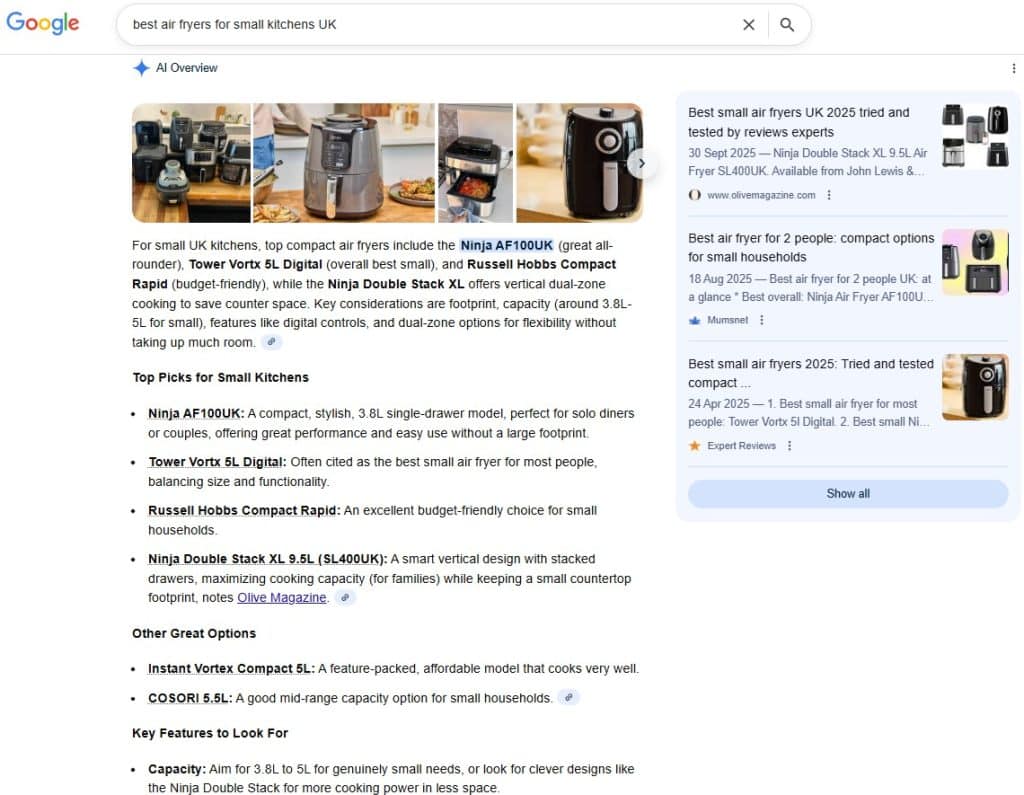
For brands that have spent years building authority and ranking for these high-value keywords, it’s a bit of a kick in the teeth. Google is essentially scraping the best bits of their content to provide a ‘zero-click’ answer, keeping the user on the SERP and away from actual websites. Review sites are also likely to be very highly impacted by this change, as traditional SERPs are being pushed about 30-40% of the way down the page once the AIO is expanded.
It’s also worth noting that the same Semrush report revealed that in just 12 months, the percentage of keywords triggering an AI Overview has also grown heaps across commercial (8.15% to 18.57%) and navigational (0.84% to 10.33%) search queries.
Ads, ads, and more ads
As if the SERP quality and UX weren’t already shit enough, you can expect to see more AI Overviews including “Sponsored” products or search ads cropping up very soon.
It’s a classic Google move: create a feature that pushes organic results further down the page, then sell you back the space you just lost. If you want to remain visible in this new layout, your paid search strategy is going to need some serious attention. Oh, and budget. Lots of yummy budget.
Now it makes sense for Google to be ramping up AIOs for commercial and transactional searches, eh?
Localisation: a silver lining?
If there’s one bit of good news, it’s that the AI seems to be getting a bit better at recognising we’re actually in the UK. A small victory.
In the early days of AIOs, we were constantly being served US-centric advice and .com citations. Thankfully, we’re seeing a much higher frequency of UK-specific sources like the NHS, .gov.uk sites, and major UK publishers like Which? or The Guardian.
This suggests that if you’re producing high-quality, locally relevant content, you’ve still got a fighting chance of being cited as a “trusted” source in the AI carousel. But let’s be honest – being a citation is a poor substitute for a direct click.
What can I do to limit the impact of AIOs on my website traffic?
I’ve said it before, and I’ll say it again: you can’t just ignore AI and hope it goes away. Here’s how I’d be tackling this:
- Stop chasing boggo “what is” traffic: If your content only answers basic questions, the AIO has already won. Focus on content that requires actual expertise, personal experience, original research and data, and a unique brand voice – things an LLM still can’t fake. TBH, you should have already been doing this long before AIOs became more prominent.
- Monitor your commercial keywords: Keep a close eye on your top-performing transactional terms. If an AIO has suddenly appeared, your CTR is likely going to take a hit. You’re either going to need to take a smarter approach to optimising your bottom-of-funnel pages, or, unfortunately, use PPC in the meantime to plug the gap.
- Get your feed in order: If you’re in e-commerce, ensuring your product data is clean and accessible via Google Merchant Centre is now more important than ever, as this is where the AIO often pulls its ‘recommendations’. There are additional benefits to having a well-optimised feed, so you shouldn’t just be doing this for AIO visibility.
It’s clear that AI Overviews aren’t just an experiment anymore – they’re a core part of the commercial search journey. It’s disruptive, and it’s probably going to give us all a few more grey hairs, but it’s the reality of search in 2026.