
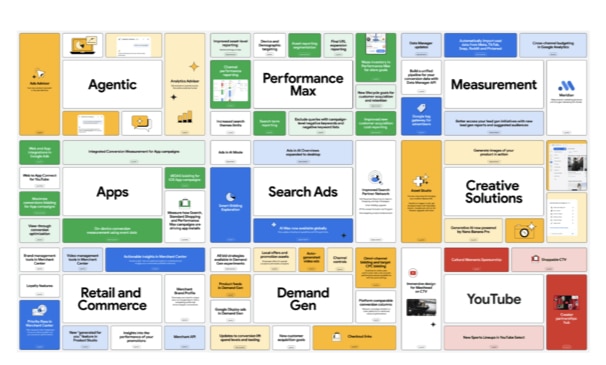
2025 marked a transformative year for Google Ads, with artificial intelligence taking centre stage, yet again. Here’s what you need to know about the features that were added/updated in 2025.
AI Max
Search advertising entered a new chapter this year, and AI Max is leading the charge as Google’s fastest-growing AI-powered Search product.
This is what Google claims makes AI Max so powerful:
- Advanced targeting and creation features designed to maximise relevance and reach
- Text customisation (this is rolling out to all languages and verticals by the end of the year)
- New experiments and text guidelines giving advertisers more creative control
- AI-powered optimisation that learns from your business to deliver better results
But AI Max isn’t working alone. Google introduced Smart Bidding Exploration, which uses flexible ROAS targets to discover new traffic opportunities. Google says that early results show “an 18% increase in unique search query categories with conversions and a 19% increase in conversions”.
Ads now appear in AI Overviews in the US and are being tested in AI Mode for complex, multi-step queries. These placements put brands directly into helpful AI-powered responses, meeting customers at the exact moment they’re making decisions.
The Search Partner Network also received major upgrades, including full placement reporting and enhanced geo-targeting to better allocate spend and reduce unwanted traffic.
The mixed reality of AI Max
The feedback on AI Max is a tale of two experiences, sharply divided between Google’s optimistic case studies and the more cautious real-world experiences reported by agencies and independent advertisers.
In my opinion, AI Max isn’t ready yet and should only be used in the following scenarios:
- Expanding reach rather than replacing core campaigns – campaigns that have already maxed out impression share on existing keywords could benefit, as AI Max identifies incremental volume that cannot be captured simply by increasing bids.
- Testing rather than committing – Google has now rolled out AI Max experiments in the UK, which is an easy way for advertisers to see if the feature is for them or not, without affecting their current performance.
- Top-of-funnel exploration – AI Max can be effective for top-of-funnel research queries, however maintaining clear messaging can be more challenging for complex products/services.
Performance Max
Performance Max campaigns are said to be the most intelligent way to reach audiences across Google’s ecosystem, and 2025 brought the transparency and control advertisers have been requesting. Finally!
Reporting breakthroughs:
- Channel-level performance reporting now shows exactly how campaigns perform across Google’s full range of channels
- Complete search terms reporting provides the same granularity as traditional Search campaigns
- Asset-level reporting expanded to include impressions, clicks, and cost – not just conversions
- New segmentation options break down asset performance by device, time, conversions, and networks
Control where it matters:
- Campaign-level negative keywords can now be easily added (up to 10,000 per campaign) to exclude unwanted queries
- Search themes have been expanded from 25 to 50 per asset group for greater reach
- Demographic and device targeting for more precise audience control
YouTube
YouTube remains the ultimate platform where brands meet audiences across every screen and format. This year’s innovations focused on connected TV, cultural moments, and creator partnerships.
Connected TV takes centre stage:
- Shoppable CTV allows viewers to browse and purchase products directly from the big screen
- Immersive Masthead design expands cinematic content edge-to-edge on the YouTube homepage
- Maximum attention capture on the biggest screen in the house
Demand Gen
Demand Gen campaigns saw a 26% increase in conversions for the cost, driven by over 60 AI-powered improvements. The platform combines visual assets across YouTube, Discover, Gmail, and now the Google Display Network.
New performance tools:
- New customer acquisition goals optimise campaigns specifically for first-time or high-value customers
- Target CPC bidding for click-focused campaigns
- Omni-channel bidding optimises for both online sales and in-store visits
- Product feeds transform ads into virtual storefronts with instant product details
Creative and inventory expansion:
- Auto-generated videos help brands increase YouTube reach
- Image inventory across Google Display Network extends visual reach across the web
- The option to choose where ads appear with channel controls
Measurement updates
Google emphasised a critical truth in 2025: AI is only as effective as the data that powers it. Several groundbreaking measurement tools have been launched to help businesses build that foundation:
Meridian MMM “built by Google for today’s consumer journeys to help make smarter, data-driven decisions when measuring outcomes across channels.”
Data Manager is a centralised hub that unifies data from websites, apps, physical stores, and CRM platforms. Build data strength once and drive better ROI across Google Ads, Search Ads 360, and Campaign Manager 360.
Google Tag Gateway for advertisers improves measurement accuracy and security, with advertisers seeing an average 14% uplift in signals after configuration.
Asset Studio powered by Nano Banana Pro
Creating high-performing assets used to take days. Now it can take minutes, with Asset Studio powered by Nano Banana Pro – Google’s advanced generative AI model.
These tools are free and available to all Google Ads users, democratising professional creative production:
What does this all mean for advertisers?
The 2025 Google Ads landscape represents another fundamental shift from manual campaign management to AI partnership.
As we move further into this AI-powered era, one thing is clear: the future of advertising isn’t about replacing human expertise with automation. It’s about augmenting human creativity and strategy with AI’s ability to process signals, test variations, and optimise at a speed and scale impossible for humans alone.
As an agency, we’ve learned that fighting AI isn’t the answer – learning to conduct the orchestra is. AI is an incredibly powerful tool that can save us hours, even days, on tedious work like data analysis and number crunching. But here’s the thing: it’s not a replacement for marketing expertise; it’s an amplifier of it, and it requires a lot of guidance. Success comes from knowing when to trust the machine and when to override it, but also how to best steer it.
For the full Google Ads 2025 roundup, see here: https://support.google.com/google-ads/answer/16756291?sjid=5238372355625385502-EU